
Why Gear Noise Matters in Agricultural Equipment
Gear whine, rattle, and harmonic vibration in farm equipment is more than an annoyance — it is a signal of mechanical stress that compounds over time. In enclosed operator cabs, persistent gear noise contributes to operator fatigue across long working shifts. In gearboxes and drives that run continuously, elevated noise correlates with higher dynamic tooth loads, increased heat generation, and faster bearing wear. Choosing the right gear type from the start is the most effective way to control noise before it becomes a service problem.
The two most common gear profiles in agricultural machinery — spur gears and helical gears — produce fundamentally different noise and load characteristics from the same materials and at the same operating speed. Understanding why they differ helps specify the correct type for each location in a drivetrain, and helps identify which gear profile to source when ordering replacements.
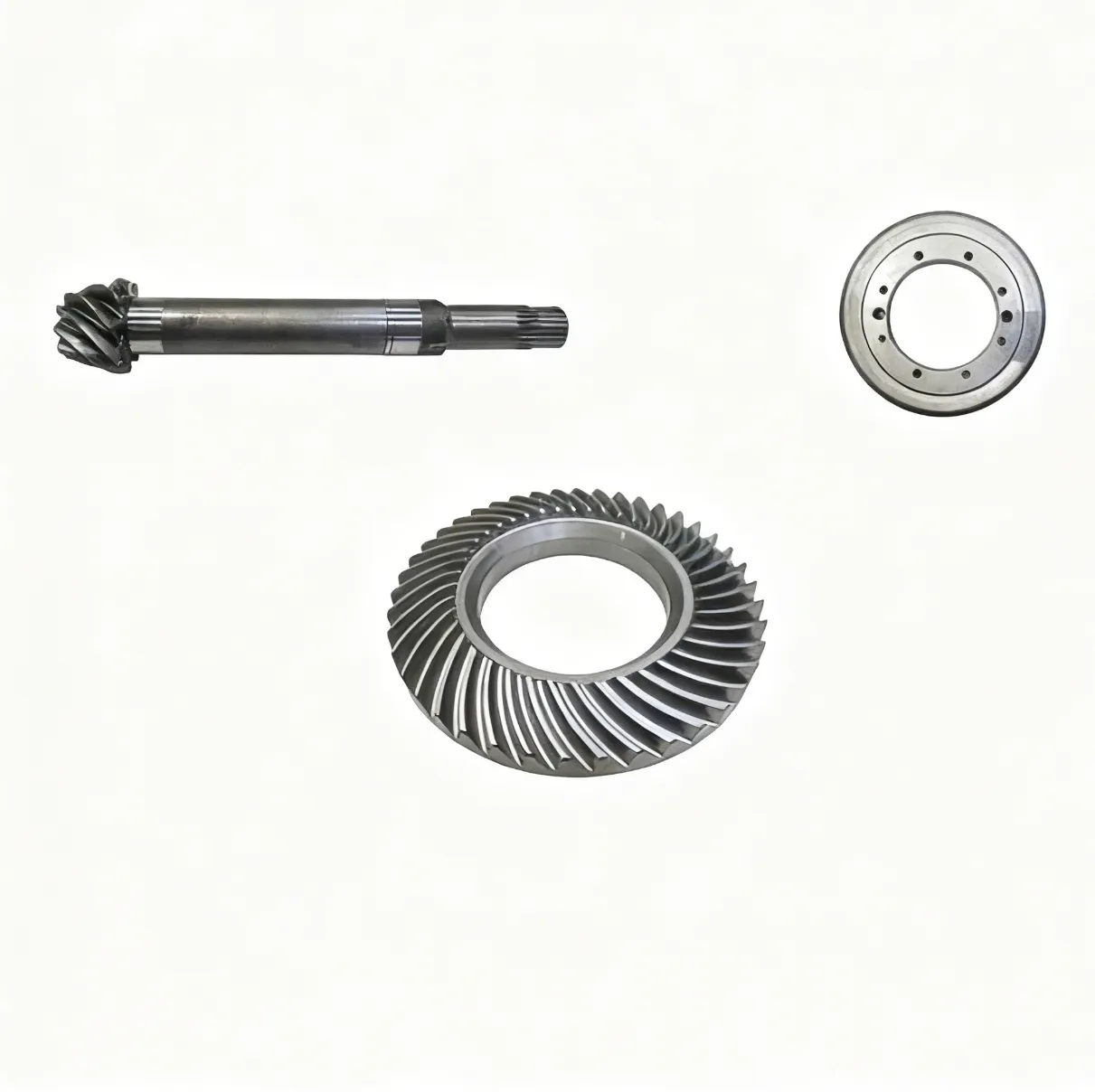
Spur Gears: Simple, Strong, and Noisy Under Load
Spur gears have teeth cut parallel to the gear axis — straight teeth that engage across the full tooth width simultaneously as each pair of teeth comes into contact. This full-face engagement produces a high, consistent load capacity, but also a characteristic impact at each tooth engagement cycle. At low speeds the impact is minor; at higher speeds the repeated engagement and disengagement of successive tooth pairs creates audible noise and vibration proportional to gear pitch and rotational speed.
Where spur gears perform well
Spur gears are the default choice for low-speed, high-torque applications where noise level is not a constraint. Slow-moving conveyors, seed drill ground drives, slow-speed auger drives, and chain sprocket reduction stages in tillage equipment frequently use spur gear reductions. Their manufacturing simplicity makes them cost-effective for applications that prioritize durability and ease of replacement over smooth, quiet operation. When a gear fails in a remote field location, a spur gear replacement is far easier to source quickly than a precision helical equivalent.
Axial load consideration
A key advantage of spur gears is that they generate no axial (thrust) loads — tooth forces are entirely radial. This means bearing selection is simpler, and existing radial-load bearings in a housing can accept spur gear loads without modification. In contrast, helical gears generate both radial and axial loads, requiring thrust-capable bearings that add cost and complexity to housing design. For retrofits and replacements in older implement gearboxes, spur gears often remain the most practical option.
Helical Gears: Quiet Running Through Progressive Engagement
Helical gears have teeth cut at an angle to the gear axis — typically 15–30 degrees of helix angle in agricultural applications. This angular cut means that as a tooth pair comes into contact, engagement begins at one edge and progressively sweeps across the full tooth face rather than engaging all at once. At any given moment, more than one tooth pair is typically in contact simultaneously (a higher contact ratio), which distributes load across multiple teeth and dramatically reduces the per-engagement impact that causes spur gear noise.
Noise reduction in practice
At equivalent pitch, material, and speed, helical gears typically operate 6–12 dB quieter than spur gears — a reduction that is clearly perceptible to operators and measurable with a sound level meter. In tractor transmission shafts, PTO drive reduction stages, and high-speed gearbox input stages, the difference between spur and helical gear sets is one of the most impactful single choices for cabin noise reduction without structural modification to the equipment itself.
Load capacity advantage
The higher contact ratio of helical gears also translates directly to load capacity. For the same gear module and face width, a helical gear set handles approximately 20–30% higher transmitted load than an equivalent spur set. This is why transmission countershafts, differential ring and pinion gears, and high-speed reduction stages in modern tractor gearboxes almost universally use helical geometry — both for noise and for the load capacity needed at those shaft speeds and torque levels.
| Factor | Spur Gear | Helical Gear |
|---|---|---|
| Tooth engagement | Instantaneous (full face) | Progressive (swept) |
| Noise level | Higher | 6–12 dB lower |
| Load capacity (same size) | Baseline | ~20–30% higher |
| Axial thrust load | None | Yes — requires thrust bearings |
| Manufacturing cost | Lower | Higher |
| Typical farm use | Slow drives, augers, conveyors | Transmission, PTO stages, final drives |
Values are approximate and vary by module, face width, helix angle, and material grade.
Herringbone Gears: The Double-Helix Option
A herringbone gear combines two opposing helical sections on the same gear face — one left-hand helix and one right-hand helix meeting at the center. This arrangement preserves all the noise and load advantages of helical geometry while canceling out the axial thrust forces, since the two helix halves produce equal and opposite thrust that balance internally. The result is a gear that runs quietly under high load without generating any net thrust on the shaft bearings.
Herringbone gears are found in the highest-power stage applications: large tractor power-shift transmission countershafts, industrial combine drives, and heavy-duty gearboxes where both noise control and maximum load density are priorities. They are considerably more expensive to manufacture than single-helix designs and are not field-replaceable items — when a herringbone stage fails, it typically requires a complete gearbox replacement or specialist rebuilding.
Selecting Replacement Gears: What to Specify
When a gear needs replacement in an agricultural drivetrain, five specifications must be confirmed before ordering to ensure the replacement matches the original performance envelope.
The fundamental tooth size parameter. Module = pitch diameter / tooth count. Must match exactly — even one module increment means teeth will not mesh correctly with the mating gear.
Determines the gear ratio with the mating gear. Must exactly match original to preserve operating speed, torque ratio, and spacing between shaft centers.
The axial length of the tooth. Determines load capacity alongside module. Replacing with a narrower face width reduces load capacity even if module and tooth count match.
Either 20° (most common in modern agricultural equipment) or 14.5° (older designs). Mixing pressure angles between mating gears causes incorrect tooth contact and rapid failure.
Case-hardened steel (typically 20CrMnTi or 17CrNiMo6 grade in agricultural gearboxes) provides a hard surface over a tough core. A softer replacement material will wear faster regardless of dimensional correctness.
Need Replacement Gears for Your Equipment?
PRR Tractor Part stocks spur and helical gears for tractor transmissions, implement gearboxes, and PTO drive applications. Provide module, tooth count, and shaft bore dimensions for a matched replacement.
Көп берилүүчү суроолор
Source the Right Gear for Your Application
Our team matches spur and helical gear replacements to your equipment specs — module, tooth count, material, and bore diameter confirmed before dispatch.
PRR Tractor Part Limited Partnership | [email protected]
304/1170 Soi Phahonyothin 49/1, Intersection 6, Talat Bang Khen Subdistrict, Lak Si District