
How Gear Ratio Affects Tractor Implement Speed and Torque Output
Gear ratio is the single most important number in any mechanical drive system, yet it is rarely discussed in operator-level documentation. Most agricultural equipment manuals list final working speeds and recommended PTO settings without explaining the gear reduction chain that produces those outputs. Understanding how gear ratio works — and what it means for the tractor-implement interface — gives operators a clearer picture of why certain implements work better on certain tractors, and helps diagnose performance problems that are not caused by any mechanical failure.
This guide explains gear ratio from first principles, covering how it affects implement working speed and available torque, how reduction ratios stack in multi-stage gearboxes, and what happens when the ratio does not match the application.

What Gear Ratio Means — The Basic Relationship
Gear ratio is the relationship between the rotational speed of the input (driving) gear and the output (driven) gear. A ratio of 3:1 means the input gear completes 3 full rotations for every 1 rotation of the output gear — the output speed is one-third of the input speed. This speed reduction comes with a corresponding torque multiplication: if the input gear is spinning at one-third the output gear’s speed, the output gear produces three times the input torque (before accounting for efficiency losses). Speed and torque always trade off in inverse proportion in a gear drive.
The fundamental formula
Gear ratio = Input tooth count ÷ Output tooth count (for a speed increase), or Output tooth count ÷ Input tooth count (for a speed reduction). For a practical example: a driving gear with 12 teeth meshing with a driven gear of 36 teeth produces a ratio of 36 ÷ 12 = 3:1 reduction. The driven shaft rotates at one-third the input speed, with three times the input torque available. Knowing this formula allows you to calculate the working speed of any gear-driven implement component if you know the tooth counts and the PTO input speed.
How Reduction Ratios Stack in Multi-Stage Gearboxes
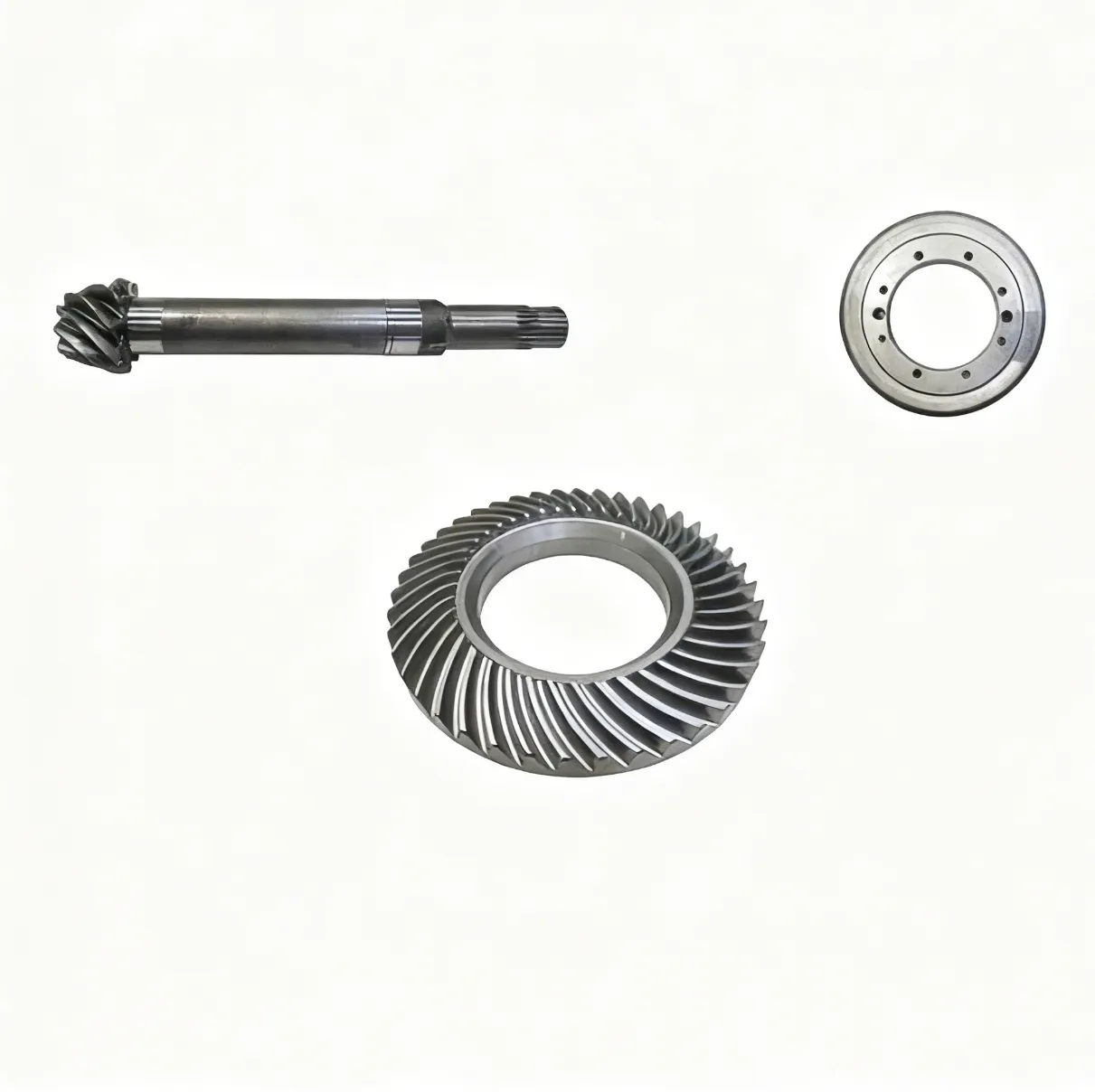
Most agricultural implement gearboxes achieve their total reduction through multiple gear stages in series rather than a single pair of gears. Two stages at 3:1 each produce a total ratio of 3 × 3 = 9:1. Three stages at 3:1 produce 27:1. This stacking of ratios allows gearbox designers to achieve very large total reductions — like the 30:1 or 50:1 reductions needed for auger or mixing drives — using gear pairs of moderate individual ratio, which are easier to manufacture and more efficient than extreme single-stage ratios.
Calculating implement tool speed from PTO input
Given a PTO input of 540 RPM and a total gearbox reduction of 3:1, the implement’s output shaft rotates at 540 ÷ 3 = 180 RPM. If the output drives a chain and sprocket combination with a further 2:1 ratio (a 10-tooth driving sprocket and a 20-tooth driven sprocket), the final working head speed is 180 ÷ 2 = 90 RPM. This type of calculation allows you to verify that any replacement gearbox or sprocket maintains the correct final working speed — and to predict the effect of a different tooth count on working head performance.
Why Torque Multiplication Matters for Soil-Engaging Implements
For implements that engage soil directly — rotary tillers, subsoilers, disc bedders, and strip-till units — the available torque at the working tool determines the implement’s ability to work in heavy, wet, or compacted soil conditions. An implement with a deep reduction ratio (high ratio number) produces high torque at the working head, allowing it to push through difficult soil without stalling. An implement with a shallow reduction produces higher working speed but less torque per tool — better for lighter soils at faster travel speeds.
Matching gear ratio to soil type and tractor power
For heavy clay or compacted soil, a deeper reduction ratio (higher number, e.g. 5:1 or 6:1 in the implement gearbox) combined with a slower tractor travel speed is the correct approach — it maximizes the torque available per tine pass, ensuring complete soil engagement even under high resistance. For lighter, sandy, or pre-worked soil, a shallower reduction combined with faster travel speed covers ground more efficiently without over-working the tractor’s PTO drive. Running an implement with a ratio too shallow for the soil conditions causes the tractor’s PTO to lug — losing RPM under load — which accelerates universal joint and implement gearbox wear.
Gear Ratio and Cutting Speed in Rotary Implements
For rotary cutting implements — rotary cutters, finishing mowers, and flail mowers — the correct gear ratio produces a blade or flail tip speed in the range of 100–200 mph for effective vegetation cutting. The ratio is set by the implement manufacturer during design and should not be altered by changing sprocket sizes or replacing the gearbox with a different ratio unit. A ratio that produces too-slow tip speed results in vegetation wrapping around the rotor shaft rather than being cut and discharged cleanly. Too-fast tip speed accelerates blade wear and dramatically increases the implement’s PTO power demand, potentially exceeding the tractor’s PTO capacity.
What Changes When You Replace a Gearbox With a Different Ratio
When sourcing a replacement gearbox for an agricultural implement, always verify the replacement unit’s ratio against the original specification. A gearbox that is physically identical in mounting dimensions but carries a different reduction ratio will change the implement’s working tool speed — sometimes with unexpected results. A slightly faster ratio on a rotary tiller produces more aggressive soil engagement and higher PTO power demand. A slower ratio on a rotary cutter reduces blade tip speed below the effective cutting threshold. Browse our range of айыл чарба редукторлору and confirm the ratio specification before ordering any replacement unit to ensure your implement continues to perform as designed.
Көп берилүүчү суроолор
Need Gears or Gearboxes with Confirmed Specifications?
We stock replacement gears and gearboxes with documented ratio, HP, and mounting specifications across all major agricultural brands.
PRR Tractor Part Limited Partnership | [email protected]
304/1170 Soi Phahonyothin 49/1, Intersection 6, Talat Bang Khen Subdistrict, Lak Si District