
كيفية قياس وحدة التروس بدون أدوات خاصة
Identifying the module of an unknown gear is one of the most common practical challenges in agricultural machinery maintenance — particularly when replacing gears in older equipment where service documentation has been lost, or when sourcing replacement parts from a supplier that requires a module specification rather than an OEM part number. The module can be determined accurately using a digital caliper and basic arithmetic, without a gear tooth caliper or optical comparator. The method works for any standard metric spur or helical gear with undamaged teeth.
This guide covers two measurement methods for identifying gear module, how to confirm the result, and what to do when the calculated value falls between standard module values.
What Is Gear Module?
Module (m) is the fundamental parameter that defines tooth size in the metric gear system. It equals the pitch diameter divided by the number of teeth: m = d / z, where d is the pitch diameter in mm and z is the tooth count. Module determines everything about the tooth’s proportions — addendum, dedendum, tooth thickness, and root fillet radius are all defined as multiples of the module. Two gears can only mesh correctly if they have the same module and the same pressure angle. Standard modules follow the series: 1, 1.25, 1.5, 2, 2.5, 3, 4, 5, 6, 8, 10 — with 1 used only for very small instrument gears and 8–10 for heavy industrial drives. Agricultural gearbox gears typically fall in the 3–6 module range.
Method 1: Outside Diameter and Tooth Count
This is the most accurate method for external spur gears with undamaged tooth tips. The formula is: m = OD / (z + 2), where OD is the outside (tip) diameter measured across the full gear including the tooth tips, and z is the tooth count.
Example: A gear with 24 teeth and an outside diameter of 130 mm. m = 130 ÷ (24 + 2) = 130 ÷ 26 = 5.0. This is module 5.
Method 2: Span Measurement (Useful for Worn Gears)
When tooth tips are worn and outside diameter is unreliable, the span measurement method uses the measurement across a specific number of teeth with calipers closed on the tooth flanks rather than the tips. For a 20° pressure angle gear (standard for agricultural applications), measure across k teeth where k = z × 0.111 + 0.5 (rounded to nearest integer). The span measurement W = m × cos(20°) × (π × (k − 0.5) + z × inv(20°)), where inv(20°) = 0.01490. In practice, for a module 4 gear: W across 3 teeth ≈ 35.5 mm; for module 5 across 3 teeth ≈ 44.4 mm. Measure your gear and compare to the table for standard modules to identify the match.
| وحدة | OD per tooth (mm) | Span over 3 teeth (20° PA, approx.) | Common agricultural use |
|---|---|---|---|
| 2 | 2.0 mm / tooth | ~17.8 mm | Metering mechanisms, small drives |
| 3 | 3.0 mm / tooth | ~26.7 mm | Light gearboxes, tiller chain stage |
| 4 | 4.0 mm / tooth | ~35.5 mm | Standard gearboxes, harvester heads |
| 5 | 5.0 mm / tooth | ~44.4 mm | Medium gearboxes, baler drives |
| 6 | 6.0 mm / tooth | ~53.3 mm | Heavy gearboxes, combine drives |
What to Do When the Result Falls Between Standard Values
If your calculated module is, for example, 3.6, it is most likely module 4 with tip wear reducing the measured OD, or a non-standard module used by a specific manufacturer. Try the span measurement method as a cross-check — if the span measurement also points to a value between module 3 and module 4, the gear may be an inch-diametral-pitch gear rather than a metric module gear. In that case, calculate the equivalent DP: DP = 25.4 ÷ m. A calculated module of 3.17 corresponds to DP 8 — a very common inch-system gear size. Browse our agricultural gear catalog and contact our team with your measurement results for assistance identifying the correct replacement.
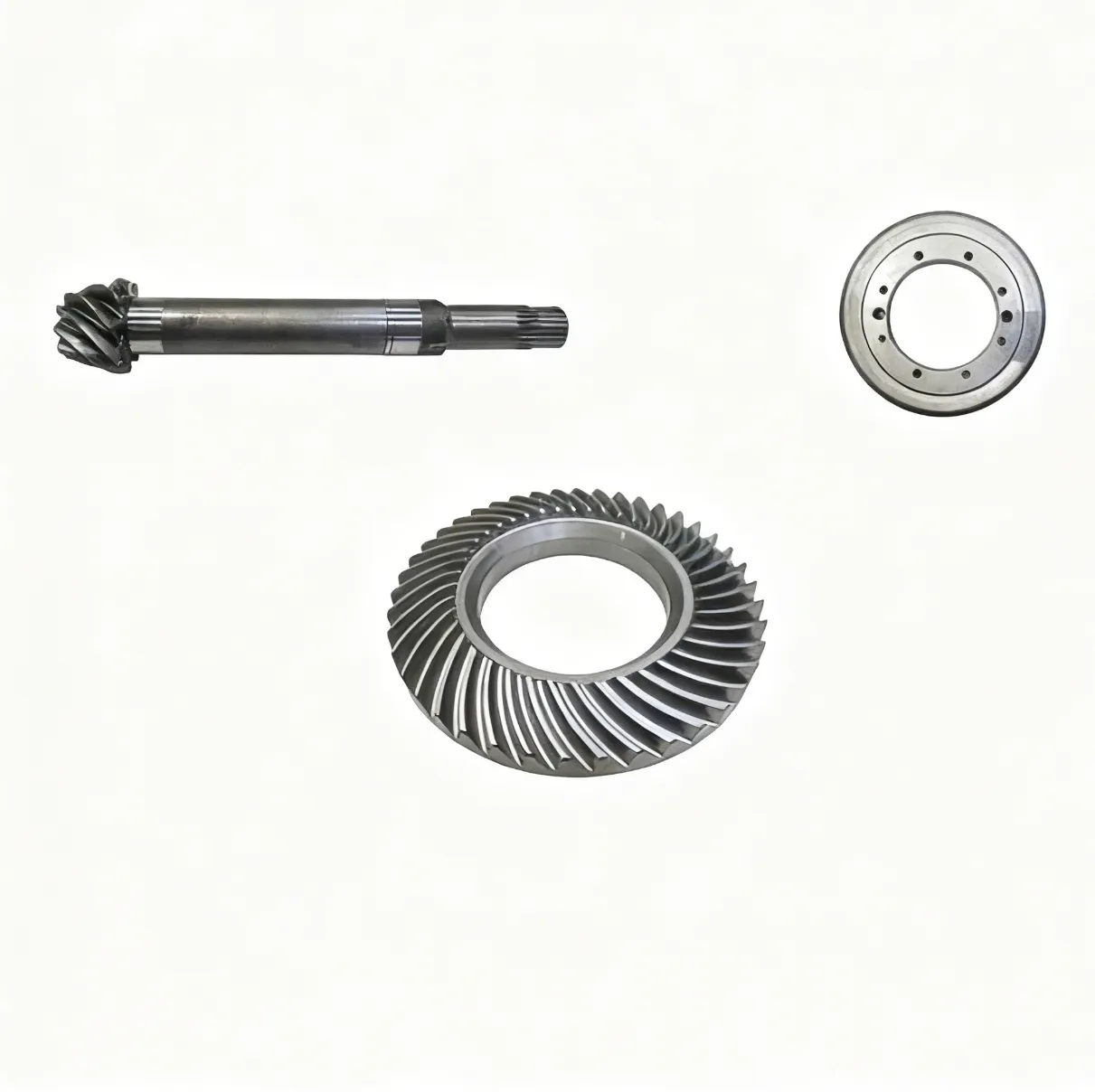
Agricultural Replacement Gears by Module and Tooth Count
PRR Tractor Part stocks spur, helical, and bevel gears in modules 2–8 for agricultural drives. Provide your measured OD, tooth count, bore diameter, and calculated module for a confirmed replacement.
الأسئلة الشائعة
Agricultural Gears by Module — Spur, Helical and Bevel
Module 2–8 in stock for agricultural gearboxes and implement drives — provide your measured specification for a confirmed replacement.
PRR Tractor Part Limited Partnership | [email protected]
304/1170 سوي فاهونيوثين 49/1، تقاطع 6، منطقة طلعت بانج خين الفرعية، منطقة لاك سي