
Why the Gearbox Type Matters on a Farm
Selecting an agricultural gearbox is rarely straightforward. Walk into any dealer and you will encounter bevel gearboxes, worm reducers, and planetary drives — each designed around fundamentally different operating principles, suited to different implements, duty cycles, and power requirements. Specifying the wrong type means either premature failure or a system that never delivers the output characteristics your implement actually needs.
This guide explains the engineering principles behind each major gearbox type, the specific implement applications where each performs best, and the practical signals that indicate which type you should be replacing or sourcing when servicing agricultural equipment.
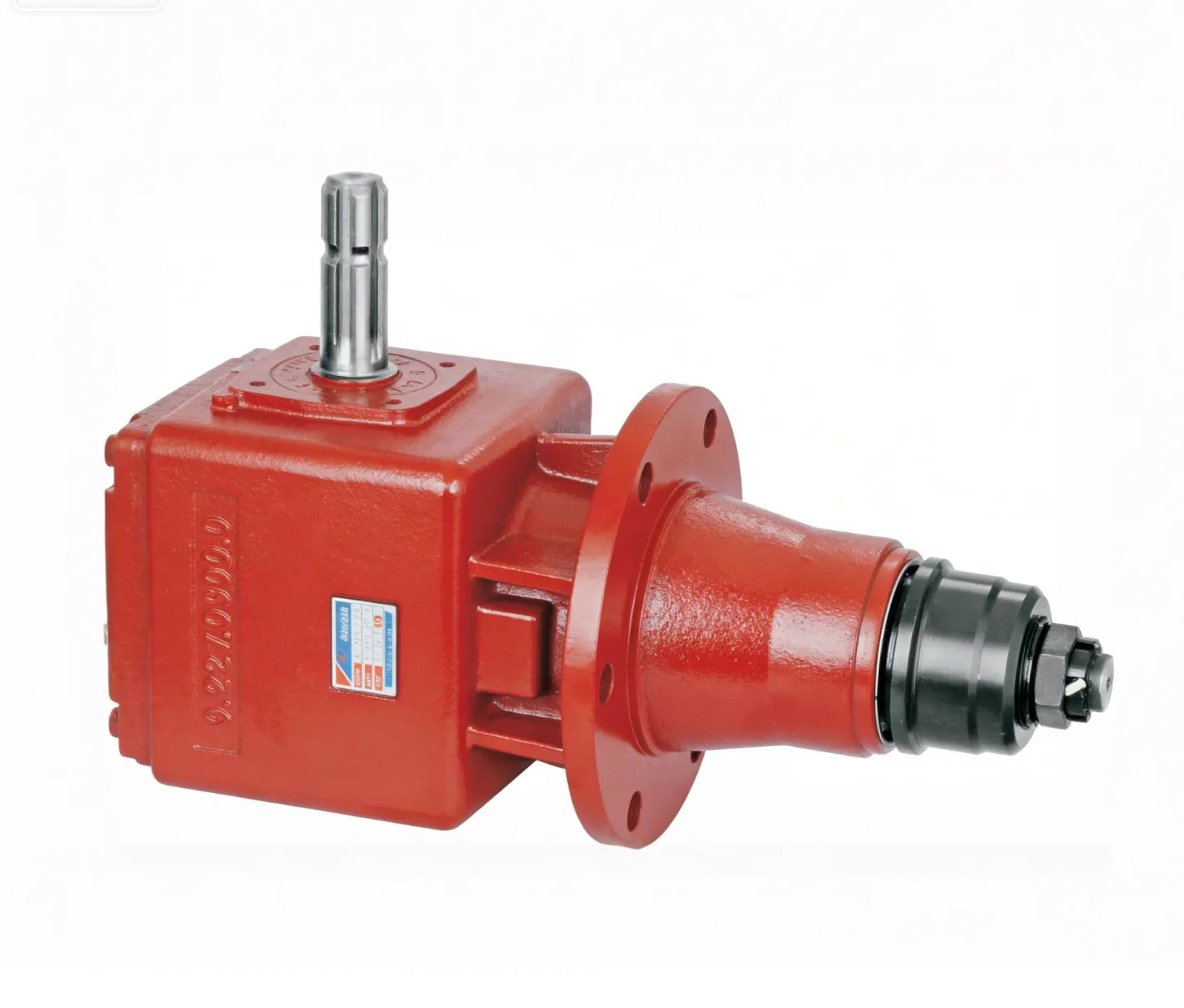
Bevel Gearboxes: Right-Angle Power Transmission at High Efficiency
A bevel gearbox uses conically shaped gear teeth to transfer torque between two shafts set at an angle — most commonly 90 degrees. The geometry of bevel gears allows power to change direction while maintaining high mechanical efficiency, typically 95–98% in a straight bevel design. This efficiency advantage makes bevel gearboxes the default choice for any implement where the PTO input shaft must redirect to drive a perpendicular working component.
Where bevel gearboxes are used
Rotary cutters and bush hogs use a single right-angle bevel gearbox to redirect PTO shaft input from horizontal to vertical, driving the cutting blade assembly below the deck. Disc mowers and disc harrows use multiple bevel gearboxes in series to drive individual disc gangs from a single PTO input shaft. Post-hole diggers use a bevel box to convert horizontal PTO rotation to the vertical auger. Any implement requiring a 90-degree direction change with maximum power efficiency is a natural fit for a bevel gearbox.
Spiral vs straight bevel
Two variants exist within the bevel family. Straight bevel gears have teeth cut parallel to the cone surface — simple to manufacture but noisier at speed and lower in load capacity. Spiral bevel gears have curved, angled teeth that engage progressively rather than all at once, producing quieter operation, higher load capacity, and better distribution of tooth load. Modern agricultural rotary cutter gearboxes universally use spiral bevel geometry for this reason. When sourcing a replacement, confirm whether your application requires a straight or spiral bevel design, as housing dimensions may differ even if the ratio is identical.
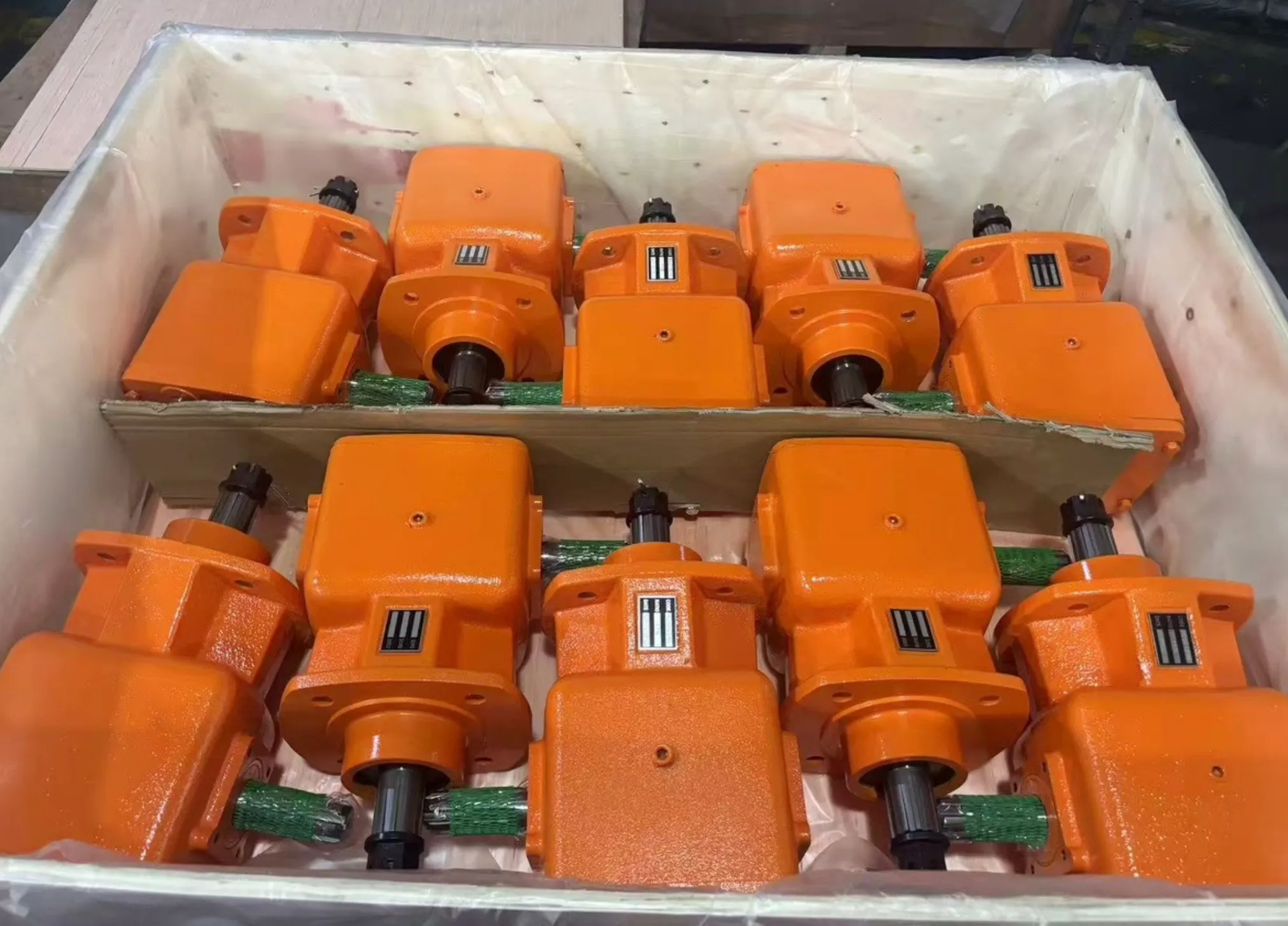
Worm Gearboxes: High Reduction Ratios in Compact Form
A worm gearbox uses a helical screw (the worm) meshing with a toothed wheel (the worm gear) set at 90 degrees. This arrangement produces large speed reduction in a single stage — ratios from 5:1 to 100:1 are achievable in a relatively compact housing. The inherent sliding contact between worm and wheel creates self-locking behavior in most ratios, meaning output shaft torque alone cannot backdrive the input — a safety advantage in lifting or positioning applications.
Where worm gearboxes are used in agriculture
Fertilizer spreader drives, seed metering mechanisms, auger speed reducers, and slow-speed conveyors frequently use worm gearboxes. Any implement requiring a low output speed with high torque from a compact housing is a candidate. Irrigation drive systems that must hold position under load — where back-driving would cause runaway — benefit directly from worm self-locking. Gate actuators and slow-moving chain conveyors on grain handling equipment also commonly use worm reducers.
Efficiency limitation
Worm gearboxes carry a significant efficiency penalty compared to bevel or spur gear designs. Due to the sliding contact geometry, mechanical efficiency typically runs 50–90% depending on lead angle and lubrication — lower ratios lose more power to heat. In high-duty-cycle applications this heat buildup requires adequate housing size and in some cases active cooling. For this reason, worm gearboxes are not used where efficiency is the primary concern — they are chosen for their reduction ratio and compactness despite the efficiency trade-off.
Planetary Gearboxes: Maximum Power Density for Heavy Implements
A planetary gearbox — also called an epicyclic gearbox — uses a central sun gear, a ring of planet gears orbiting around it, and an outer ring gear. Power is distributed across multiple planet gears simultaneously, spreading load across several tooth contacts at once. This parallel load sharing allows planetary gearboxes to achieve very high torque capacity in a remarkably small and lightweight housing — the key reason they appear in the most power-dense agricultural applications.
Agricultural applications for planetary drives
Large round baler final drives, heavy-duty tiller gearboxes, combine grain header drives, and tractor final reduction hubs commonly use planetary arrangements. The combination of high torque capacity, compact size, and collinear input/output shafts — where input and output share the same centerline axis — makes planetary systems ideal for inline power concentration at the end of a driveline. Wheel-hub planetary reducers on large tractors transfer power from the axle shaft to the wheel at the highest torque point in the drivetrain, minimizing axle shaft stress.
Ratio range and efficiency
A single-stage planetary gearbox achieves ratios of roughly 3:1 to 10:1. Higher ratios require compounding — two or more planetary stages in series. Mechanical efficiency is high, typically 95–97% per stage, because tooth contact is primarily rolling rather than sliding. This makes planetary gearboxes suitable for continuous-duty, high-power applications where worm drives would overheat and bevel boxes would require impractically large housings.
| Tipo | Efficienza | Ratio Range | Output Shaft | Best Use Case |
|---|---|---|---|---|
| Bevel | 95–98% | 1:1 to 6:1 | 90° to input | Rotary cutters, disc mowers |
| Worm | 50–90% | 5:1 to 100:1 | 90° to input | Spreaders, augers, conveyors |
| Planetary | 95–97% | 3:1 to 10:1 (per stage) | Inline (coaxial) | Balers, tillers, wheel hubs |
Efficiency values are approximate and vary with load, lubrication, and operating temperature.
How to Identify Which Gearbox Type You Have
When sourcing a replacement gearbox, identification is the first challenge — particularly on older implements where data plates may be missing. Three features allow visual classification of most agricultural gearboxes without disassembly.
If input and output shafts emerge at 90 degrees, the unit is either bevel or worm. If they share the same axis (coaxial), the unit is almost certainly planetary.
With the input disconnected, try to rotate the output shaft by hand. If it locks and will not backdrive, the unit is almost certainly a worm gearbox. Bevel and planetary types will rotate freely.
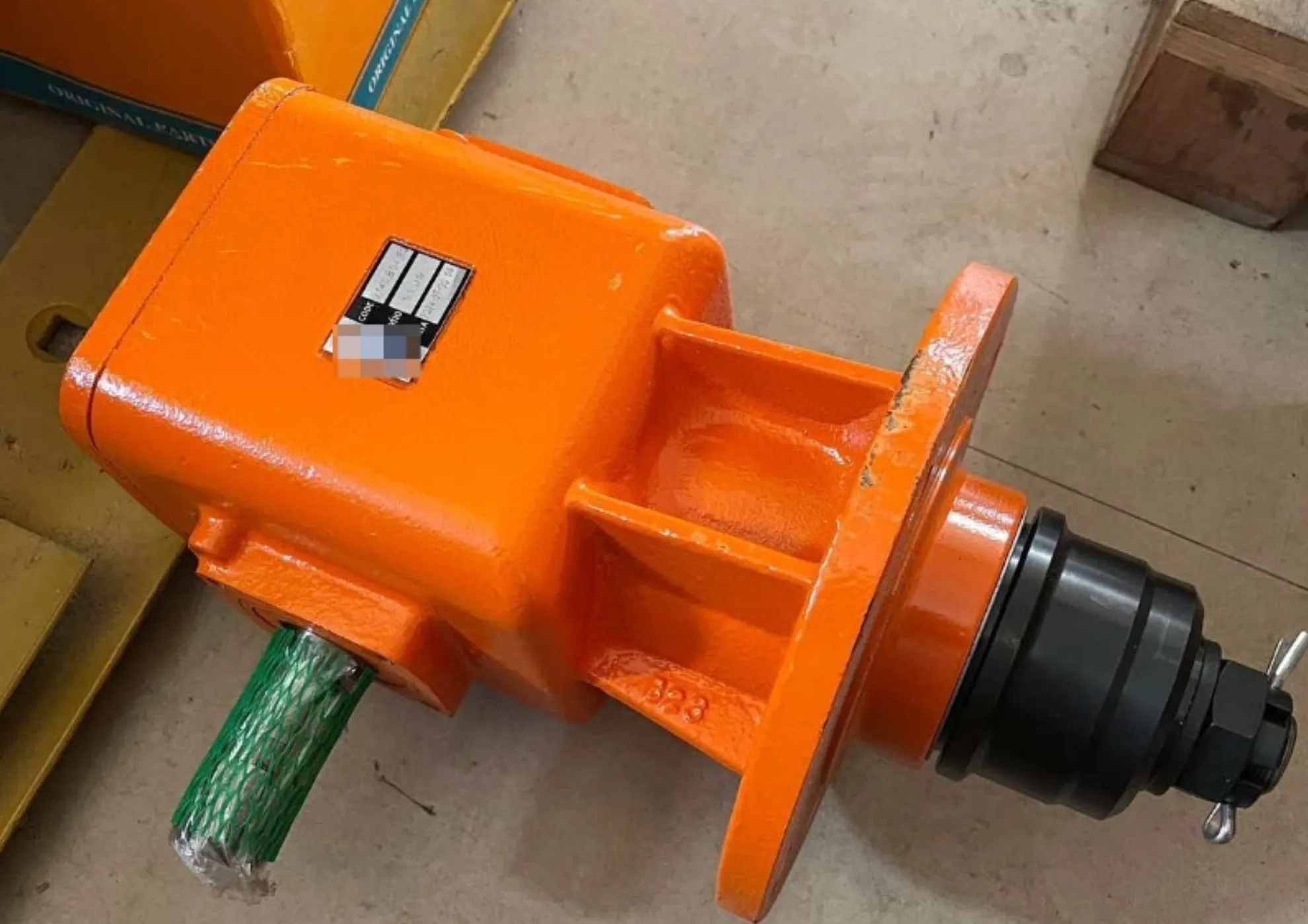
Bevel boxes tend to be compact and roughly cubic at the right-angle junction. Worm boxes have an elongated shape housing the worm shaft on one side. Planetary units are typically cylindrical with a circular cross-section.
Looking for an Agricultural Gearbox Replacement?
PRR Tractor Part stocks bevel, worm, and right-angle gearboxes for rotary cutters, disc mowers, tillers, and more. Provide your implement make and model for a matched recommendation.
Gearbox Oil and Maintenance Requirements by Type
Each gearbox type has different lubrication requirements, determined by the contact mechanics of its gear geometry. Using the wrong lubricant — or the right lubricant at the wrong service interval — is the primary driver of premature agricultural gearbox failure.
Bevel gearbox lubrication
Spiral bevel gears require a hypoid-grade gear oil — typically GL-5 rated — that contains extreme-pressure additives to manage the sliding contact component of spiral tooth engagement. Standard GL-4 transmission fluid is insufficient for hypoid bevel applications and will allow accelerated tooth wear. Oil level must be maintained to the check plug level; the bevel contact zone must remain submerged or splash-lubricated at all times. Service interval is typically every 50–100 operating hours or annually, whichever comes first.
Worm gearbox lubrication
Worm gearboxes generate significant sliding friction heat and require a dedicated worm gear oil — commonly ISO VG 220 or 460 grade with strong film-forming and thermal stability properties. Some manufacturers specify synthetic worm gear oils for extended temperature range. Because sliding generates more heat than rolling contact, oil level and condition monitoring is more critical in worm boxes than in bevel types. Overheating is the primary failure mode — if the housing becomes too hot to touch briefly, the oil level, condition, or viscosity grade is wrong for the application.
Planetary gearbox lubrication
Planetary gearboxes generally accept the same high-quality gear oil used in the tractor’s axle housing — commonly SAE 80W-90 or 85W-140 GL-5 rated. Because planetary systems distribute load across multiple planet gears and carry high torque in compact housings, oil quality directly affects bearing life as much as gear tooth life. Planetary gearboxes integrated into tractor final drives typically share the transmission or hydraulic fluid circuit and benefit from the tractor’s oil filtration system. Standalone planetary units on implements require independent oil change schedules. For a useful external reference on gearbox oil specifications and selection methodology, see this agricultural gearbox technical guide.
Domande frequenti
Need the Right Gearbox for Your Implement?
Our parts team identifies bevel, worm, and planetary replacements by implement type and PTO speed — fast sourcing, verified specs.
PRR Tractor Part Limited Partnership | [email protected]
304/1170 Soi Phahonyothin 49/1, Intersezione 6, sottodistretto di Talat Bang Khen, distretto di Lak Si