
The Problem with Rough Pasture Clearing
Rough pasture clearing sits in an awkward middle ground between light mowing and heavy land clearing. The vegetation is too coarse and dense for a standard finish mower, but usually does not require the aggression of a heavy forestry mulcher. Choosing between a flail mower and a rotary cutter for this type of work determines not just cutting quality — it determines maintenance cost, blade replacement frequency, and how well the machine survives contact with buried rocks, thick stalks, and tangled overgrowth.
Both implement types handle rough pasture, but they do it differently and with different trade-offs. This guide explains the mechanical differences, covers the real-world performance distinctions for rough terrain, and helps identify which replacement blade design best matches your actual clearing conditions.
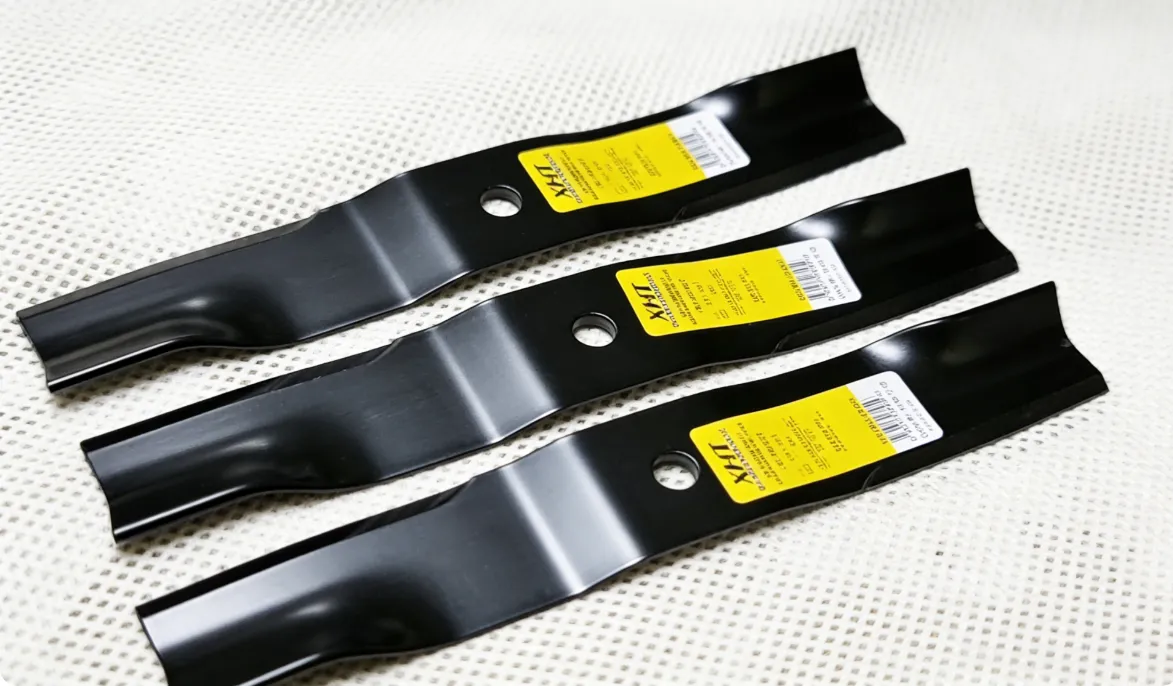
How Flail Mowers Cut: The Swing-Hammer Principle
A flail mower operates on a horizontal rotor — a shaft spinning perpendicular to forward travel direction — with individual blade elements (flails) mounted to the rotor on free-swinging pivot pins. As the rotor spins at high speed, centrifugal force holds the flails extended outward. When a flail contacts vegetation, it slices or hammers through the material, and if it strikes a solid obstacle — a rock or buried debris — the flail swings backward on its pivot rather than shearing, absorbing the impact and protecting both the rotor and the gearbox.
Flail blade shapes for rough pasture
Two flail shapes dominate rough pasture work. Y-blades (also called knife blades) have a forked profile with cutting edges on both arms of the Y — they produce a cleaner, more uniform cut on lighter vegetation and grass stands. Hammer blades (also called T-blades or club blades) are heavier, blunter tools that pulverize woody stems and coarse material by impact rather than clean slicing. For genuine rough pasture with a mix of grass, light brush, and reed or bullrush stands, hammer blades typically outlast Y-blades and handle the material range better, though finish quality suffers compared to knife-type flails.
Mulching effect and crop residue
Flail mowers shred cut material into small pieces that remain on the soil surface, accelerating decomposition and returning nutrients to the pasture. The enclosed rear chamber of most flail decks keeps material circulating under the hood until it reaches a small enough size to pass through the rear deflector. For pasture renovation where leaving a mulch layer is desirable, this is a significant advantage over the large-piece clippings left by rotary cutters.
How Rotary Cutters Cut: The Horizontal Disc Approach
A rotary cutter (bush hog) uses one or more heavy horizontal blades rotating at high speed in a horizontal plane, driven from the top by a vertical-shaft bevel gearbox connected to the PTO. The blade swings through vegetation at high tip speed, severing material by impact and shear. Unlike flail blades, rotary cutter blades are rigidly mounted or use a loose-pinned pivot that allows limited swing-back but not the full free-swinging travel of a flail system.
Blade types on rotary cutters
Standard rotary cutter blades are flat, heavy steel sections with sharpened leading edges. Serrated or stump-jump variants exist for specific applications. The blade assembly on a rotary cutter stores significant rotational kinetic energy due to its mass and speed — this energy carries the blade through dense material without stalling, but also means the machine requires a clear safety zone around the rear discharge area, where severed material exits at high velocity.
Cutting capacity advantage
For heavy, woody brush — saplings up to 2–3 inches in diameter, thick bull thistle stands, mature Johnson grass clumps — a rotary cutter’s blade mass and tip speed deliver more raw cutting power per pass than most flail configurations. The blade simply has more momentum behind each impact. Flail mowers of equivalent cutting width typically struggle with material above 1–1.5 inches diameter unless specifically configured with heavy hammer flails and an appropriately powered tractor.
| Factor | Flail Mower | Rotary Cutter |
|---|---|---|
| Rock impact safety | High — flails swing back on impact | Moderate — blade damage risk |
| Heavy brush cutting | Moderate (up to ~1.5 in dia.) | High (up to 3 in dia.) |
| Finish quality | Better (finer chop) | Coarser (large sections) |
| Mulching residue | Yes — fine mulch layer | Minimal — coarse clippings |
| Blade replacement cost | Lower per unit, more pieces | Higher per unit, fewer pieces |
| Discharge direction | Downward (contained) | Rear discharge (projectile risk) |
Performance comparisons apply to similar width implements at equivalent tractor HP.
Blade Replacement: Flail vs Rotary Cost and Frequency
Blade wear and replacement costs differ substantially between implement types, and this difference becomes significant over a full operating season of rough pasture work.
Flail blade replacement patterns
A standard flail mower carries 16–48 individual flail blades depending on rotor width. Individual blades wear unevenly depending on operating conditions — the outside blades of the rotor sweep the widest arc and encounter more material, wearing faster. Flail blades are relatively inexpensive individually, but the total count means a full re-blade on a wide rotor represents meaningful cost. The advantage is that only worn or damaged blades need replacing — you are not forced to replace the entire rotor assembly. See our lawnmower blade range for compatible flail blade options.
Rotary cutter blade replacement patterns
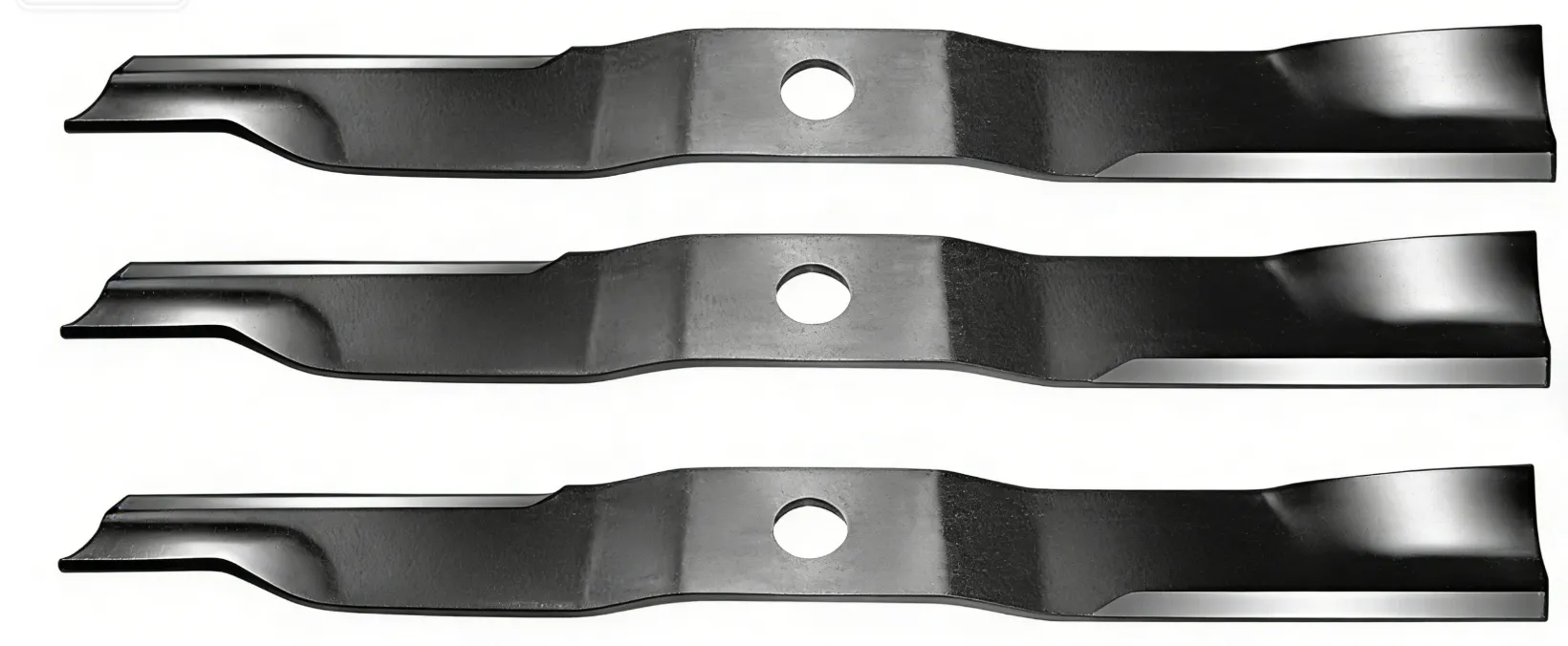
A single-blade rotary cutter has one or two blade assemblies — dramatically fewer pieces to track, but each blade is heavier and more expensive per unit. Rotary cutter blades must always be replaced in matched sets to maintain rotor balance — replacing only one blade on a dual-blade assembly creates an imbalance that produces severe vibration, bearing damage, and potential gearbox housing cracking. Always order replacement blades in the correct set quantity for your specific model. Our blade catalog includes matched set replacement options for common rotary cutter models.
Which Is Best for Rough Pasture Clearing?
For most rough pasture scenarios, the decision comes down to two questions: how rocky is the ground, and how thick is the heaviest material?
Ground is rocky or has hidden debris; material is mostly grass and light stems under 1.5 inches; mulching quality matters; you work near roads or fences where projectile discharge is unsafe.
Vegetation includes woody brush or saplings over 1.5 inches; the land is relatively clear of buried rocks; cutting volume is high and speed matters more than finish quality; cost per pass is the primary concern.
For operations with truly mixed conditions — some rocky sections, some open brush areas — many farmers run a rotary cutter as the primary clearing tool and use a flail mower for follow-up passes to reduce residue and improve pasture presentation. The implements complement each other across a season’s clearing program.
Source Replacement Mower Blades
PRR Tractor Part stocks flail blades, rotary cutter blades, and matched replacement sets for major implement brands. Provide your mower make and model for a confirmed fitment.
Domande frequenti
Ready to Order Replacement Mower Blades?
We supply flail blades, hammer blades, and rotary cutter sets with verified fitment for major implement brands.
PRR Tractor Part Limited Partnership | [email protected]
304/1170 Soi Phahonyothin 49/1, Intersezione 6, sottodistretto di Talat Bang Khen, distretto di Lak Si