
Roller chain tension on agricultural machinery is one of the most frequently incorrect adjustments found during equipment inspections. Over-tensioned chains wear out bearings prematurely and can fracture under impact loads. Under-tensioned chains jump sprockets, generate vibration, and wear sprocket teeth unevenly. The correct tension is specific to the drive geometry — the centre distance, the chain span, and whether the drive is horizontal, inclined, or vertical — and cannot be guessed reliably without a simple measurement.
This guide covers the correct tension measurement method for agricultural roller chain drives, how to adjust tension using the most common adjustment mechanisms, and how often to re-check tension during the operating season.
The Correct Tension Target
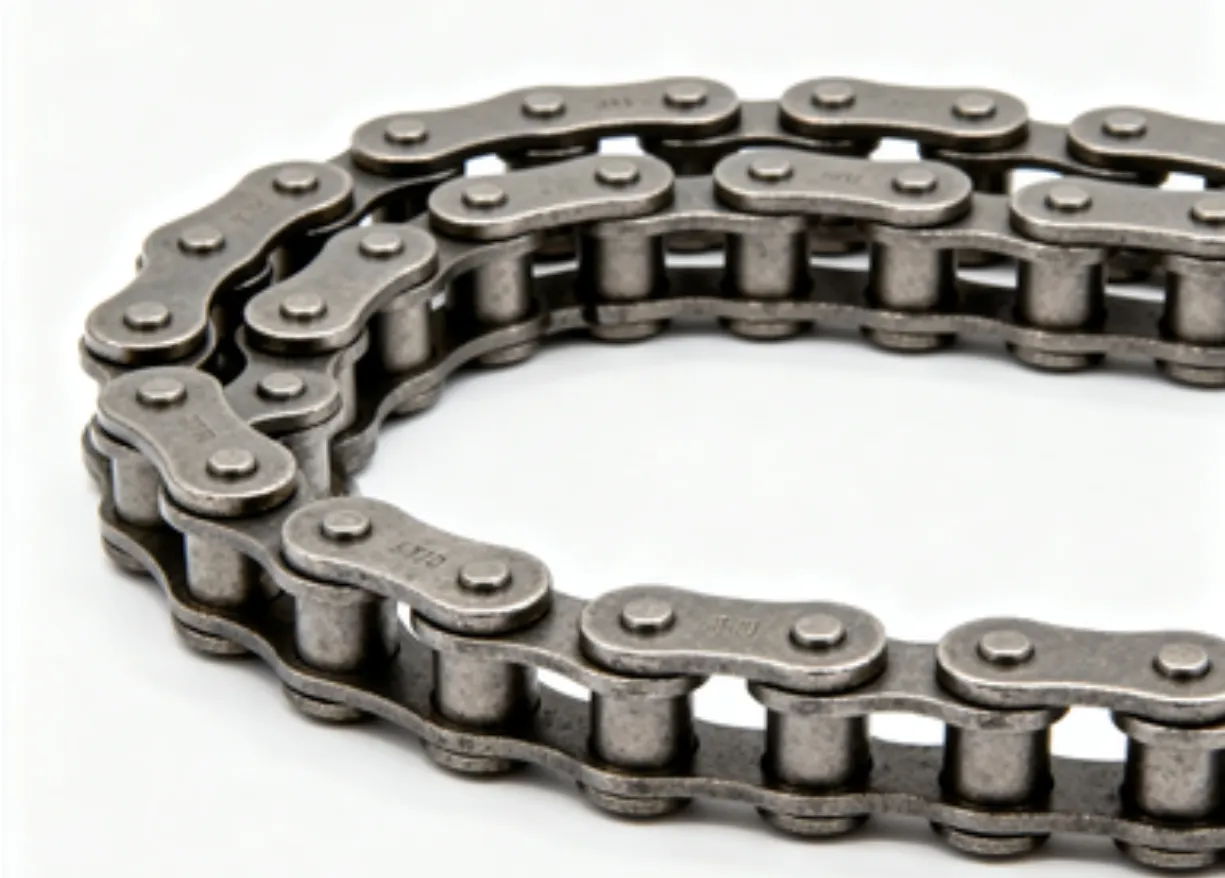
The industry standard for agricultural and industrial roller chain drives is a slack-span sag of 1–2% of the sprocket centre distance, measured at the midpoint of the slack (unloaded) span with the machine stopped and at rest. For a 400 mm centre distance, the correct sag is 4–8 mm of deflection when the midpoint of the slack span is pressed with moderate finger pressure — approximately 5–10 N.
This 1–2% range applies to standard horizontal drives where the slack span is on the bottom (the chain returns along the bottom from driven to drive sprocket). For non-standard drive orientations, adjust as follows:
How to Adjust Chain Tension on Farm Equipment
Sliding centre distance adjustment
The most common tension adjustment method on agricultural equipment is a slotted mounting that allows one of the sprocket shafts to slide in or out, changing the centre distance and therefore the chain tension. To adjust: loosen the shaft mounting bolts, push or pull the shaft to achieve the target sag, and re-tighten the bolts evenly. Re-check sag after tightening — the shaft often moves slightly when the bolts are torqued. Recheck tension after the first 4–8 hours of operation on a new or recently adjusted chain, as new chains seat into their operating pitch during initial running in.
Fixed centre distance with spring tensioner
Some drives use a fixed centre distance with a spring-loaded idler sprocket or a sliding tensioner shoe that bears against the chain slack span. These maintain tension automatically as the chain elongates. Check that the tensioner is not at the end of its adjustment travel — a tensioner that has been fully extended by chain elongation can no longer compensate for further elongation. When the tensioner reaches its limit, chain replacement is due regardless of the measured elongation, as no further tension adjustment is possible.
How Often to Check Chain Tension
| Aandrywingsoort | Check Frequency | Notes |
|---|---|---|
| New chain (first 50 hours) | Every 8–10 hours | New chains seat and elongate rapidly |
| Established chain (seasonal use) | Weekly during season | More frequent in dusty / wet conditions |
| High-speed drives (>600 RPM sprocket) | Every 25 hours | Higher wear rate from speed |
| Low-speed ground drives | Monthly during season | Lower wear rate, easier to access |
Browse our range of landbou-kettingwiele for replacement drive components. If chain tension issues persist despite correct adjustment, the underlying cause is usually chain elongation or sprocket wear — contact [email protected] for a diagnosis and replacement recommendation.
Agricultural Sprockets and Chain Drive Components
PRR Tractor Part stocks sprockets for all common agricultural pitches. Contact us with your pitch, tooth count, and bore dimensions for matched replacements.
Gereelde vrae
Agricultural Chain Drive Sprockets in Stock
ANSI #35–#80 and ISO equivalents — standard tooth counts, matched bore and hub dimensions, immediate stock.
PRR Trekkeronderdele Beperkte Vennootskap | [email protected]
304/1170 Soi Phahonyothin 49/1, kruising 6, Talat Bang Khen-subdistrik, Lak Si-distrik